|
|
|
|
|
|
|
| What
is the Old Brain and
why is it important
to YOU?
In
addition to the Right
Brain and Left Brain,,
the brain is categorized
in
3 separate parts
which act as separate
organs with different
cellular structures
and different functions.
|
| On
the way to the development
of the human brain,
mankind went through
several phases. First
there was a brain stem,
which is the inner and
most primitive layer.
It is the part of the
brain that overseas
such functions as reproduction,
self-preservation, circulation
of the blood, breathing,
sleeping, and the contractions
of muscles in response
to external stimulation.
|
| This
brain stem sits on top
of the spinal column
in the base of the skull.
This is the 'Old
Brain'--sometimes referred
to as the "reptilian
brain" because
all vertebrates from
reptiles to mammals
have one. This is the
brain that ultimately
makes all final decisions.
|
|
| Research
in neurosciences demonstrates
that although the 3 brains
communicate with each other,
each one has a specialized
function: |
|
|
 |
 |
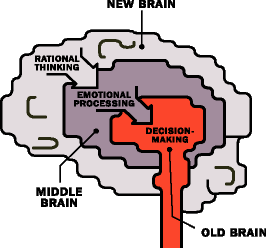
The
"New Brain"
thinks. It processes
rational data and shares
its deductions with
the other two brains. |
|
The
"Middle Brain"
feels. It processes
emotions and gut feelings
and also share its findings
with the other two brains. |
|
The
"Old Brain"
decides. It takes input
from the other 2 brains
but it controls the
decision making process.
|
| Once
you know that the
true decision-maker
is the Old Brain, your
entire sales and marketing
strategy should apply
completely different
communication principles
in order to be impactful. |
|
 |
|
|
|
 |
|
|
| |
|
 |
|
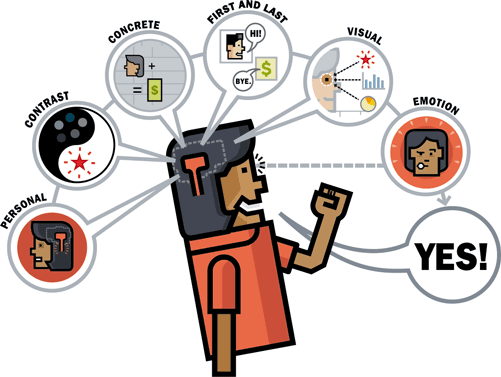
The 'Old Brain' is
a very self-centered
entity and general
considerations about
others do not reach
it. Think of the ''Old
Brain'' as the center
of ME. Do not assume
that it has any patience
or empathy for anything
that does not immediately
concern its survival
and well-being. |
 |
|
Before/after, with/without,
slow/fast all allow
the Old Brain to decide.
Contrast is a safe
decision engine. It
allows the 'Old Brain'
to make quick and
safe decisions. Without
contrast, the 'Old
Brain' enters a state
of confusion, which
ultimately results
in delaying decision. |
 |
|
Numbers work for the
New Brain, but the
'Old Brain' won't
decide based on numbers
alone! The 'Old Brain'
is constantly scanning
for what is familiar
and friendly, what
can be recognized
quickly, what is tangible
and immutable. The
'Old Brain' cannot
process concepts like
"flexible solution",
"integrated approach",
or "scalable
architecture"
without efforts and
doubts. |
 |
|
The 'Old Brain' forgets
most everything in
the middle. This short
attention span has
huge implications
on how to construct
and deliver powerful
messages. Placing
the most important
content at the beginning
is a must, and repeating
it at the end an imperative.
Keep in mind that
anything you say in
the middle of your
delivery will be mostly
overlooked. |
 |
|
The 'Old Brain' is
visual. Neuroscience
demonstrates that
when you see something
that looks like a
snake, your 'Old Brain'
warns you instantly
of danger so that
you react even before
the New Brain physically
recognizes it's a
snake. This implies
that visual processing
enters the 'Old Brain'
first which can lead
to very fast and effective
connection to the
true decision-maker. |
 |
|
The 'Old Brain'
is strongly triggered
by emotions. Neuroscience
has clearly demonstrated
that 'emotional
cocktails'- create
chemical reactions
that directly impact
the way information
is memorized and
processed by the
'Old Brain'.
|
| |
| Links
to More about Neuroscience
and the Brain |
| |
|
|
|
|
|
|
|
|
|
|
|
|
|
|