|
Because
proving the GAIN is so important, we asked an
expert in the area of GAIN, Dr Richard Peterson, a
Stanford Neuro-scientist, to elaborate on the topic
using the latest brain research. Dr. Peterson is an
expert in Neuro-economics, a new practice that he
has pioneered examining the stunning discoveries on
how the brain works while making complex financial
decision.
..........................................................................................................
Gain in the Brain: A Breakthrough for Your Business?
By Dr Richard Perterson --Stanford
Neuro Scientist
There is a search on today for business principles
that can cut through the fog of excessive information
and indecision. Neuroscience, a new discipline
that explores mental behavioral patterns, may be breaking
new ground in this respect. Or is its powerful application
to business practices simply a case of history repeating
itself? After all, exploring the way the brain works,
in an effort to better understand human motivation,
is a perennial pursuit.
Since the time of Aristotle in ancient Greece, scientists
and philosophers have hypothesized the existence of
two major motivational systems dwelling in
the brain. These two systems motivate our desire to
pursue potential rewards and to avoid potential losses.
They are regarded as the reward approach and the
loss avoidance systems. Old or new, these findings
are being harnessed today by organizations seeking
to deliver a solution to today's complex communications
issues. One of these companies, SalesBrain, has paid
its dues for the last several years articulating this
approach. Their view is that when we demonstrate a
GAIN to our customers, we are appealing
to the innate and ancient system of reward approach
motivation.
Scientists have shown that this "reward approach
system" exists even in life forms as primitive
as amoebas. It is the most basic motivator of activity
in the brain. The power of demonstrating a concrete
and large gain is more primitive and basic than you
may have ever imagined. When presented correctly
a concrete GAIN can activate your customers' brain
"pleasure center," and even compel them to buy your
products or services with unexpected effectiveness.
It helps to examine the underlying science.
At Stanford University, we are studying the brain
in-depth with fMRI (Functional Magnetic Resonance
Imaging) scanners. The average human brain has
100 billion neurons with 100 trillion connections
among them. As neuroscience researchers, we have only
just begun to understand the structure of the brain
and the mental life that arises within its mysterious
workings. When people are ready to engage in reward
approach, their behavior changes. They engage in greater
risk-taking, experience positive feelings, and are
more impulsive. On the other hand, loss avoidance
behavior is timid, protective, and risk averse. From
the perspective of neuroscientists, all behaviors
arise in the brain as the result of anatomical, neurochemical,
and electrical processes. With the new techniques
of neuro-imaging, we are able to visualize the
origins of buying and selling behavior, consumer decision-making,
and brand preference. Experimentally we are able to
modify information in order to influence the buying
and selling decisions of our research subjects. By
this manner of systematic experimentation, we have
discerned how the size of the GAIN dominates over
other potential reward characteristics such as the
probability or the time delay for reward. Such findings
can explain the popularity of large lotteries where
the gain presented is very high (sometimes hundreds
of millions of dollar) even though the probability
is very low. In Salesbrain parlance, the reward
system runs from the "old brain" through the "middle
brain" and ends in the neocortex (the "new brain").
The neurons that carry information between these brain
sections along the reward pathways are called dopaminergic
neurons because they predominantly carry the neurotransmitter
dopamine. Dopamine has been called the "pleasure"
chemical of the brain, because people who are stimulated
in the dopaminergic centers of the brain report intense
feelings of well-being and sometimes orgasm during
the stimulation.
Several experimental stimuli have been found to activate
the brain's reward system. In our experiments we use
money as a prototypical reward. Money is rewarding
and desired by everyone, and it is easy to manipulate
in terms of time delay, quantity, and probability.
The best way to visualize the power of "demonstrating
the gain" is to observe the following whole-brain
cross-sectional images.
 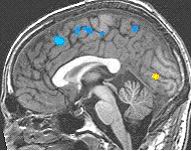
The image to the left represents the impact of both
reward and probability together (expected GAIN), the
image to the right represents the power of GAIN "probability"
in activating the brain, and the third image below
represents the power of gain "size" in activating
the brain.
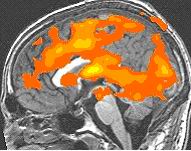
As you can see, overall the brain is much more
responsive to changes in GAIN size than to equivalent
changes in probability. The impact of a demonstrated
GAIN in expected value terms (magnitude*probability).
This may be why people have trouble planning for the
future, including retirement investment. The impact
of a demonstrated GAIN in probability terms. This
may be why people have trouble distinguishing middle
range probabilities from each other. The impact of
a demonstrated GAIN in magnitude (size) terms. This
may be why people play the lottery (big reward). In
demonstrating GAIN to our customers, we are appealing
to the innate and ancient system of reward approach
motivation. This potential GAIN appeals to the brain
in specific, and measurable ways.
The strides neuroscience is making in understanding
how the mind works applies to the buyer: and that
can mean sales success. Salesbrain has devised an
application of these discoveries to the sales process.
The bridge they have built from the laboratory to
the marketplace is being road-tested with Fortune
1000 companies. Science predicts that the results
will be apparent as in the SalesBrain model you are
supposed to not only maximize the amount of
GAIN that is presented to the clients but also the
quality of the proof (probability that will receive
that GAIN) hence maximizing the impact on your client's
reward system.
..........................................................................................................
Richard L. Peterson attended
the University of Texas where he earned degrees in
Electrical Engineering and Arts in 1995. Dr. Peterson
attended the University of Texas Medical Branch (medical
school) from 1996 to 2000 where he received the Ford
Award for Excellence in Psychiatry and earned a doctor
of medicine degree (M.D.). He completed his psychiatry
specialty training in 2004, and at present he continues
as a psychiatrist in private practice and a managing
partner of Market Psychology Consulting. Dr. Peterson
has been managing his own stock and commodity investment
accounts for the past 13 years, and for the past 5
years the accounts have been managed with psychology-based
systems. Visit his web site at http://www.richard.peterson.net/Neuroeconomics.htm
to find out more about his research.
..........................................................................................................
|