| ||||||||||||||||||||||||||||||||||||||||||||||||||||||||||||
NEWS
SalesBrain Webinar
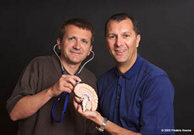
Join Christophe and Patrick February 24th at 11am PST for a FREE webinar sponsored by Eloqua (click here).
Recent discoveries in neuroscience have shed new light on the craft and delivery of messaging that significantly motivates prospects to say “Yes”.
So, please join us for this exclusive webinar where three experienced neuromarketers will show you how to use proven science to improve your demand generation performance:
• Christophe Morin and Patrick Renvoise, founders of SalesBrain and authors of Selling to the Old Brain™, will highlight six actionable strategies for creating effective, highly-persuasive messaging.
• Mark Organ, CEO of Eloqua and an ex-neuroscientist, will explain how to take advantage of the brain's susceptibility to recency, frequency, and multiple modality messaging effects to drive exceptional results.
SalesBrain To Appear on
French Popular Television
In April 2005 Salesbrain's Patrick Renvoise and Christophe Morin will appear on the popular Prime Timetelevision series of France Envoye Especiale. This expose on NeuroMarketing features the groundbreaking ideas developped by the founders of SalesBrain and other prominent researchers
The November PBS 2004 FrontLine program, “The Persuaders”, focused on marketing and advertising communication techniques. For more on their industry documentary including material on NeuroMarketing Click Here.
According to Public Television Producer Mary Carmichael: "NeuroMarketing, in one form or another, is now one of the hottest new tools of its trade. At the most basic levels, companies are starting to sift through the piles of psychological literature that have been steadily growing since the 1990s' boom in brain-imaging technology. Surprisingly few businesses have kept tabs on the studies - until now. "
SalesBrain Expands Globally
Milan, Italy. SalesBrain book and workshops were introduced for the first time in new European locations and are being met with critical acclaim. A full page SalesBrain article under the following headline appeared in ItaliaOggi (November, 2004), Milan's leading daily business newspaper:
The Method To Communicate With The Most Ancient Part Of Our Brain Has Arrived In Italy
Salesbrain, Neuroscience Beyond Marketing Frontiers
BY VALENTINA GIANNELLA
Measure Your Ability to Sell to the Old Brain. Take our short online test to see how your rate.
SalesBrain provides Research, Coaching and Training services based on the latest discoveries in Neuroscience to help you:
-
Close more deals, faster
-
Quickly raise money to grow your business
-
Boost the impact of all your external and internal messages
BOOK
Click here to learn more about the groundbreaking book, 'Selling to the Old Brain'. $29.95 - includes full-size poster illustrating this exciting approach.

Empower your group to be more effective in sales, marketing, and communication. Click here to learn more about engaging the Authors & Founders to speak at your event....
VIDEO LIBRARY
Hear more about the Old Brain from author, Christophe Morin. More...
View more videos about Selling to the Old Brain.
TESTIMONIALS
Click here to view a video testimonial from some SalesBrain's raving fans.
Version 02-17-05
All rights reserved - SalesBrain 2005
Do Your Presentations Suffer
from Powerpoint-itis?
Is the business presenter's most popular business application a tool or panacea? Sometimes a little perspective from the science of NeuroMarketing is needed to rescue our presentations and re-connect with the audience.
“Anyone can point and click his way to creating a brand new slide show. The problem is, everyone does.”
--Point of Vision Group
Introduction.
When the first version of PowerPoint went on sale in 1987, available for Macintosh and only in black and white, no one realized it would become nearly ubiquitous. Like the discovery of fire, it spread around the world and now resides on literally hundreds of millions of computers. It is has become the old reliable for visual business expression. It builds bridges between people and departments. But is it the best tool for all business presentations?
Many intone that the use of PowerPoint has become too predictable and lost its edge. Some simply have one word for it: Boring—everyone uses PowerPoint. “I will scream the next time someone’s presentation consists of them reading their slides to me. After all, what did I go to first grade for, if not learn to read?” says Mike Zellers in Wired Magazine. You can sense a little frustration. It’s understandable: communication has urgency by nature. It must engage the audience at a deep level. And in the case of sales, closing customers is life-supporting. Presentations, must reach an audience with these results.
NeuroMarketing 101: Attention Class!How then has PowerPoint become inefficient as the most reliable route to the ultimate decision maker, the Old Brain? What are its specific limits and how can we overcome them to captivate our audience?
First of all we need to recognize the Old Brain is in charge here. It will invisibly make the executive decision: boring or exciting? It will be automatic. It will be final. So, fight Power-point-it-is! To keep the Old Brain awake and tuned in we need to pay attention to several key cautions, better explained with the science of NeuroMarketing:
CAUTION PowerPoint presentations can be very impersonal.
If your presentation is centered around YOUR PRODUCTS or their related functions and features then your audience will quickly disconnect because they don’t care about your products: they only care about what your products can do for THEM.
NeuroMarketing 101:
The Old Brain is a very self-centered!
It wants to be treated with personal attention. In a way, the ''Old Brain'' is the center of ME. It has little patience or empathy for anything that does not immediately concern its survival and well-being.
CAUTION PowerPoint Presentations can be very flat.
How many times have you seen endless presentations with too many slides? How often do they contain only black and white text (even flying text is not that exciting) or include predictable, ”seen already” business clipart images:
Have you ever wondered why you have difficulty staying interested and awake during such presentation?
NeuroMarketing 101:
The Old Brain likes contrast!
Attention spans drop during a flat information continuum without contrast.
Before/after, with/without, slow/fast all engage the old brain and allow it to decide.
CAUTION PowerPoint tends to be abstract.
PowerPoint is a great tool to present complex data, levels of thinking, and abstraction. However, it has very limited ability to influence people.
NeuroMarketing 101:
The Old Brain likes simple, tangible information!
Writing 10 bullets points with the top reasons why your clients should buy from you is not enough. They need TANGIBLE proofs of what they will GAIN if they purchase your product.
CAUTIONPowerPoint puts people to sleep, especially in the middle of your presentation.
Have you noticed how difficult it is to stay focused and engaged in the middle of a typical PowerPoint presentation. Nonetheless, most presenters bring up the real value of their offering right in the middle of that presentation. PowerPoint may be a good tool to create linear structured information, but it fails to realize that the human attention follows a very specific attention/retention curve:
NeuroMarketing 101:
Old Brain remembers first and last!
The most powerful timing is the first and last part of a presentation when it is proven that attention is the highest. Anything you say in the middle of an extended delivery will be mostly overlooked.
CAUTIONPowerPoint tends to address only the ears of your audience.
People learn through 3 channels: the visual, auditory or kinesthetic channels. Yet PowerPoint is mostly auditory. Even the best presentations barely use the visual channel: a few squares, circles, arrows, bullet points and text have absolutely NO VISUAL component because you have to read them to understand the content. Furthermore, PowerPoint does nothing for the kinesthetic channel.
NeuroMarketing 101:
The Old Brain is visual!
To reach the real decision-maker, the Old Brain, you need message elements with a true visual dimension, elements that carry a strong visual metaphor. But before using one of those images from your clipart database, ask yourself: are my competitors using the same image? Is this image really bringing a new level of understanding about what the world of your customers will be once they adopt your product or solution?
CAUTIONPowerPoint creates rational, logical yet unemotional messages
How many times have you experienced goose bumps tingle or your hair rising or your heart beating stronger during a PowerPoint presentation? Yet this is a regular experience when you go to the movies. Isn’t this what you seek? PowerPoint is the emotion killer.
NeuroMarketing 101:
The Old Brain needs emotion to make a decision!
The 'Old Brain' is strongly triggered by emotions which directly impact the way information is memorized and processed by the brain. And ultimately researchers have demonstrated that only emotional input can trigger decisions.
Conclusion
Inc. Magazine asks: “Are your presentations putting people to sleep? Who hasn’t nodded off during a PowerPoint pie-chart parade?”—suggesting multimedia enhancements can wake the audience up ("Reinventing the PowerPoint”, Kevin Ferguson, March, 2004). But is adding extra audio and video sufficient?
If we are to succeed in business and communications, it is important to prevent PowerPoint-itis. Don’t miss a customer opportunity by lulling someone into a nice afternoon nap--especially now that you can recognize key symptoms of the disease. We look forward to sharing further insights on excelling in presentations through reaching the ultimate decision-maker--the Old Brain.
..........................................................................................................